Friday, February 25, 2022

Book Report: Psychonavigation Techniques for Travel Beyond Time by John Perkins (c) 1990

Psychonavigation: Techniques for Travel Beyond Time, by John Perkins (c) 1990

Background Information: Many of the books on this blog are a bit unusual. Many of the authors of these books are a bit unusual. The author of this book may be a bit more unusual than most of those. Many of John Perkins' books discuss metaphysical traditions and the indigenous cultures he learned them from. But his main claim to fame is his book "Confessions of an Economic Hitman," in which he describes his rise from a Peace Corps dropout and butterfly collector to an agent of the NSA utilizing economic incentives to manipulate third-world leaders. It's a fascinating and thought provoking book, even if the NSA has denied a lot of his claims. He has founded several non-profits devoted to environmental issues and indigenous cultures, and offers speaking engagements around the world.
https://en.wikipedia.org/wiki/John_Perkins_(author)
https://johnperkins.org/

 The core of this slim book is a meditational method to move around in your imagination in order to reach and communicate with some sort of a spirit or ancestral guide. It's a fun and potentially useful practice. But just as engaging is the story of the cultures from which the author has learned these methods. They include South American Tribal cultures and East Asian societies.

Thursday, February 24, 2022

Book Report: Mental Dominance by Julien Ochorowicz (c)1990-1887


Mental Dominance by Julien Ochorowicz (c)1990-1887

Background information: This was originally published in 1887 as "La Suggestion Mental" ("Mental Suggestion").
The author, Julien Ochorowicz, was a leading psychologist, inventor and philosopher of his day. At the time, psychology was a budding science, and included more philosophy and spiritualism than what we think of as psychology today.
https://en.wikipedia.org/wiki/Julian_Ochorowicz

If you have an interest in telepathy this will offer both some interesting scientific discussions and also practical theories and exercises to try for yourself. It's also very interesting a a view into a slice of hypnosis history when "modern" Braid-style hypnosis was taking over from Mesmerism.

The current edition (1990) mentions that it's been "updated," so I can't say for sure how much of the book is the original, and how much has been "updated." (There are a few references to telephones and television which made me highly skeptical of it's authenticity, but according to the Ochorowicz Wiki page, he experimented with early forms of telephone and television in the late 1800s!). 

Before we go farther, it's useful to get the historical context in which the author was working. More modern, suggestion-based hypnosis was beginning to dominate the psychology world, but older Mesmerism would still have been very common. What that means is that while there was more of an acknowledgement that trance and other mental states could be brought about by verbal suggestions as is practiced with hypnosis.. Mesmerism, the older science, believed that the trance was produced in the subject by the force of the Mesmerist's will which was projected into the subject's body via a magnetic fluid that was a kind of invisible psychic energy. Telepathy and other forms of psychic communication and healing were common parts of Mesmeristic belief and practice.

According to the author's Wiki bio, he worked with a number of the members of the Society for Psychical Research, which included some of the top scientists and thinkers of the day, and seems to have been a mix of skeptics and true-believers, united in applying the latest scientific methods to psychic phenomena. So it's presumable that he pulled his data from a fairly large and well documented pool of information and experiments. 

A big part of this book, or this edition, since I don;t know how closely it relates to the 1887 edition, is to identify a working methodology for mind-to-mind communication. It's pretty thorough, and offers plenty of exercises to experiment with. 

From the top, it's interesting that, presumably after experimentation, he identifies the ideal mental state as a "monomaniacal trance" which is a trance state resulting from focusing on a single thing to the exclusion of all else. This would be the kind of "modern" hypnotic trance that was used by James Braid (who suggested the term "monoideaism" --focusing on a single-- as a better name for hypnosis). Orochowicz further designates two degrees of this monomaniacal trance-- a slightly deeper, more passive one for recieving, and a slightly more active one for transmitting. 

Different scenarios are described, but it is particularly interesting that he observes that while a suggestion may be received, it may take some time for it to emerge from the subconscious of the receiver and be perceived or acted upon. He feels that a strong, persistent suggestion will be transmitted more effe3ctively than an overly intense one, and that combining the mental suggestion with some kind of physical action will be more effective than the mental suggestion alone. 

The Fourth part of the book offers exercises to strengthen one's "Animal Magnetism," which include things like visualizing and moving energy through the body, controlling your sensations of cold and heat, self-discipline and controlling emotions, etc. 

In an interesting procedure for psychic persuasion of others, the author distinguishes two parts of persuasion: Preparation and Ultimatum. (The procedure involves preparing by cultivating one's energy for a long time before your expected encounter with the person you want to persuade. When you meet them, hold overwhelmingly positive feelings, and hold your desired idea in your mind the entire time, and even imagine hugging them in you mind. Finally you make a definitive statement (mental, presumably) and they should be persuaded!). 

Another interesting observation is that these kinds of suggestions can take a longer amount of time than most other authors indicate. For a simple suggestion, this author advises 3-4 weeks of preparation, while a meaningful change of behavior may take 6 months of daily hour-long suggestions. Presumably this was backed up by some experimental data(?). 

There's a big section on finding and influencing your soulmate. I find it rather hard to believe that this was part of Ochorowicz' original manuscript, but most likely a contribution of the 1990 edition. Still, it is an interesting discussion and follows the Authors basic methodology. And again, a much longer commitment is recommended-- 40 daily sessions, with a minimum of 15!

Finally, there are a number of visualization exercises to strengthen focus and imagination, and, hopefully, one's psychic abilities. 

I can't say I've had the level of discipline to try these techniques as recommended, but if you have had results, I'd love to hear about them!


Wednesday, January 12, 2022

Almost Everything You Have to Know About SELF HYPNOSIS

So many people are curious about self hypnosis that I figured I'd put down some of the things I always tell people, and I hope I cover all the basic questions that you have. If there's more you'd like to know, please comment or email me. 

If you've ever been formally hypnotized, self-hypnosis is just a matter of reaching that same mental state by yourself. Easy! But if you've never been formally hypnotized, you might not have a clear idea of exactly what hypnosis is, so the first thing we should do is get clear on what hypnosis is. 

Hypnosis
We probably all agree that when we think of a hypnotized person, we imagine someone who has been talked into a state of deep relaxation by a hypnotist, and then given some suggestions that will affect them when they wake up. 

It's worth noting that there are TWO important elements to consider: the trance state that the subject goes into, and the suggestions that are given while he's in the trance state. Trance without suggestion is deep relaxation, suggestions without trance are affirmations

Even though the hypnotist's client looks like they may be fast asleep, the hypnotist is very particular to help them maintain their mental focus throughout the session. If a subject is not mentally focused, how can they be given effective suggestions? (James Braid, one of the 19th century pioneers of hypnosis, preferred to use the term "Monoideaism" indicating that the hypnotized subject is focused on a single idea). They may look asleep on the outside, but they're still mentally focused on the inside. In fact, one of the definitions hypnotists like to use to describe hypnosis is: Physical Relaxation combined with Mental Focus to bypass the Conscious Mind. Mental focus? YES! For this reason, it's virtually impossible to give someone a suggestion that they don't want to accept. You can't sneak much past a hypnotized client. 

The deeply relaxed trance state is useful for delivering suggestions into a person's mind because they're very relaxed and emotionally neutral, and the conscious mind isn't occupied with any thoughts, so they're open to suggestions (as long as they don't conflict with a person's beliefs or morality). 

Typically, a person goes to a hypnotist because they want to change their habits or feelings in some way, get rid of some behaviors or improve others. Sometimes instead of going and having a live session in a hypnotist's office, they'll do a session over the internet or phone, or even listen to prerecorded hypnotic sessions on MP3, CD or cassette (if they still use cassettes!). There is some very good recorded material available on line. The one advantage of a one-on-one session with a  hypnotist is that the practitioner can customize the session to the client's specific needs. Recordings tend to be a little more generalized, but people can get good results from both.

In brief:
A hypnotist CAN:
--Make you feel deeply relaxed
--Relieve Stress
--Engage your mental focus
--Give you suggestions to make the changes you want

A hypnotists CAN'T:
--Compel you to do anything you don't want to do
--Force you to go into an unconscious state
--Make you accept suggestions you don't want to accept
--Make you do things against your will
--Force you to expose your secrets
--Read your mind

Well, that's hypnosis. What about Self-Hypnosis? 

Self-Hypnosis is very similar, but you do it yourself. A lot of people are drawn to the idea of self-hypnosis because they may be shy of committing to a session with a professional, or they may be curious, but not quite yet curious enough to seek out a professional, or maybe they're just do-it-yourselfers. These are all very acceptable reasons. Self-hypnosis can be a very useful and fun activity, and it's possible to get very good results on your own with a little practice. 

With a professional hypnotist, the advantage is that they're like your personal Uber driver-- you can sit in the back seat and they will "drive" your mind to wherever you want to go. With self hypnosis, at first, it's a bit like sitting in the back seat and still trying to drive the car yourself. It feels awkward, but once you get the knack of it you can get very good results.

There are a lot of great resources on self hypnosis. You can find a lot on the web, and there are a lot of good books available (check out the Book Reports section of this blog for some suggestions). Just as with other forms of hypnosis, you're going to want to achieve a state of deep Physical Relaxation combines with Mental Focus. The simplest way is to follow a recorded hypnosis session or a guided meditation. After using it a few times, you'll probably pick up the knack without  needing the recording. 

The most difficult part of self-hypnosis, for most people, is maintaining their mental focus when they start to get relaxed. Another pitfall is that people don't always relax very deeply just because they're not aware of how deep they can go. The third big pitfall is not composing suggestions in the best possible way. This third one can be a bit trickier, since it takes a lot of skill and experience to compose suggestions that are just right for each person.

Physical relaxation can be achieved in a number of ways. Hypnotists sometimes call these deepeners. Here are a few of the common ones:
--Focusing on relaxing every part of your body, one at a time, from the toes up. Especially focus on relaxing the face.
--Count backwards from 100, exhaling and focusing on relaxation with every number.
--Focus on an object like a coin or a spot, a sound (like a word or the sound of a bell) or a feeling in your body, and gradually let go of your awareness of the environment outside your body.
--Repeating a word, poem, prayer or mantra, slowly, to the exclusion of everything else.
--Imagining sinking deeply down into a comfortable feather bed. Alternatively, imagine flying upwards into the fluffy clouds if you're not comfortable with "sinking."

You can also combine several different deepeners, one after another. This is exactly what a lot of hypnotists would do if they were hypnotizing you. These should be able to get you into a very relaxed state, and by itself, that can be a very useful thing, A state of deep relaxation is great for beating stress, and it's often given credit for all kinds of health benefits. With practice, you'll be able to both achieve deeper, more relaxing states and do it faster and more reliably. (When I was learning hypnosis, I used to challenge myself to slipping into a ten minute trance in on my lunch hour, and I would do it sitting on a bench in the noisiest, most crowded place I could find, which was Rockefeller Center in New York). When you're finished, you can count yourself back from 5 to 1 like a rocket taking off, or just gradually wake up normally. Take a deep breath, wiggle your toes and your fingers and blink your eyes. Because hypnosis is a state of focused attention, you can't "get stuck" in trance, although beginners or people who are overtired might occasionally slip into sleep.

Being able to achieve a controlled state of deep relaxation any time you want it is a terrific accomplishment all by itself, but if you're trying to make very specific changes and improvements to your habits, you're going to want to be able to give yourself suggestions that will work directly with your subconscious. Crafting effective suggestions can be a much more complicated thing than hypnosis or self-hypnosis. A good suggestion is easily accepted by the subconscious without resistance. If a suggestion makes you feel uncomfortable, that can be a sign to reexamine both your desired goal and the kind of suggestion you''re using. You can't force your subconscious mind to accept a suggestion it doesn't like. For example, a lot of people who want to lose weight will tell themselves "I am now at my desired weight and size." If that feels good, it'll work, but if it doesn't quite feel right, that the subconscious mind saying it can't work with that suggestion. The subconscious mind is very literal, and if a person is unhappy with their weight, just trying to accept that they're now at the desired weight obviously won't do the trick. It may be better to work with a suggestion like, "I am now able to easily changing my habits to lose weight and look better." Do you see the difference? The second suggestion does not ask the subconscious mind to accept anything it feels is untrue. 

My feeling about effective suggestion is that it should encompass as many different kinds of sensation as possible, and be as dynamic as possible. So if I were creating a suggestion to stop myself from smoking, I might say "I feel great about giving up cigarettes!" But I'd go a little farther. I'd think about all those times and places that I usually smoked and then envision myself doing all those things and enjoying them more without the bitter, smelly, dirty taste and smell of the smoke. I'd feel how proud I was that the people around me didn't have to suffer my smoke, and look forward to my lungs feeling strong and clear. You'll notice all the bold, italicized words are dynamic ones. They have emotional power, and words like that really resonate with the subconscious mind.  

How to put it all together-- Practice the deep relaxation work for at least a week or two before trying to add the suggestions, just so you can achieve the trance state reliably. When you're ready to try a little "changework" and you're pretty good at the trance, prepare your suggestions in advance. Write them down, make it as dynamic as possible, and be sure you feel good about them and there's no internal resistance..
Close your eyes and begin your trance process. Go as deep as you are comfortable going, into a safe and neutral state of relaxation where you no longer notice much of the outside world. Enjoy the feeling for a few moments. When you're ready, repeat your suggestion mentally or aloud, and actually imagine living out the suggestion-- feel how it feels, hear how it goes, see yourself and your surroundings. The more vivid it is in your imagination, the stronger it's effect. (If you you feel any inner resistance at this point, make a mental note of it, so you can adjust your suggestion for next time). When you've done it to your satisfaction, and you're feeling good about it, you can come back out of trance. Count yourself back as we described above, or just gradually wake yourself up. Take a deep breath, wiggle your toes and fingers and feel fantastic!

Sometimes people have amazing, immediate results, but just as often it's a gradual process. Most people will require a few weeks of daily practice to make the changes they want.

I hope that provides a clearer view of what goes into self-hypnosis, and even some things you can experiment with yourself. If you have any further questions, don't hesitate to ask me, or your local hypnotists.


Monday, January 3, 2022

Book Report: Getting What You Want by. J.H. Brennan (c) 1982

Getting What You Want by. J.H. Brennan (c) 1982

Background Information: J.H. "Herbie" Brennan is a prolific New York Times bestselling author and occultist. He has written over 100 books, including children's books, young adult, fiction and history as well as various occult subjects. 

This is a fun and practical little book about achieving your goals, the kind of thing very popular in the 70s and 80s, and again today. It's well written and well structured, and the author is an excellent and witty story teller, so the book flows. It's worth noting that this book is particularly geared towards jobseekers, but it can be applied to all kinds of things. Every self help book seems to have a guiding principle that the author sets out early, and for this book, the author not only sets it out right at the beginning of the book, but also right on the back page: "Your limitations are imaginary." It may sound kind of airy-fairy, but he very practically approaches how we too-readily accept obstacles that are self imposed and also external barriers that may not be as unyielding as we assume them to be. Part of the aim of the first part of the book is changing your attitudes and your subconscious. Of the subconscious mind, the author says "it's like having Superman for a partner, except that most of the time you don't talk to him, so he lets you go your own way."

The first part of the book includes stories to illustrate the concepts clearly to the reader, and there are several in-depth quizzes to help you self-evaluate strengths and weaknesses you may not even know you had, and to help you more clearly define your goals, so that you can adapt the principles on the book to your specific needs. 

The second part of the book offers the techniques of that the author calls "Power Play." These are various attitudes and approaches for controlling and dominating not only one's own obstacles, but situations too, like job interviews. "Power Play" includes business psychology to position yourself optimally, as well as techniques to fire up your confidence and initiative, including reframes and breathing techniques.

It's a very useful and practical little book and I'm actually surprised that after it's initial 1977 printing, it was only reprinted once in the 80s. If you come across a copy, I'm sure you'll find it a useful!


Friday, December 31, 2021

Book Report: Mesmerism Unveiled! by Leslie J. Gee (c)1885


Mesmerism Unveiled!
by Leslie J. Gee (c)1885

Background information: From what is inferred in the book, the author was a popular stage performer of mesmerism, although I was unable to find anything about his performances on line.  He seems to speak with a great deal of experience and the same kind of passion for his art that most hypnotists have today. This little book (approx 50 pages) was likely an item that he sold at his shows to those interested in learning for themselves.

While I was unable to find any information about his performances, he does include his home address (circa 1885) in order for readers to contact him if they had any questions. There is currently a somewhat rundown single-family house on the site (thanks, Google maps!) that was built in 1890. No record that I could find of the previous house or landowner.

The subtitle of this book is "The Only Work Ever Published Giving Full Instructions How to Practice and Master the Art of Psychology, or Mesmerism" and, indeed, there seems to be material that I have not seen in any other books of Mesmerism, so for novelty value alone, it's a worthwhile little volume.

Today we think of Mesmerism as a primitive kind of hypnosis, but that is not exactly the case. While is did utilize trance and suggestion to effect changes in the client, Mesmerism was based on the idea that there was an actual "magnetic fluid," an invisible energy, that ran through the nervous system, and which, with practice, could be projected to people and things to effect certain kinds of results. While mesmerism is a thing of the past, we find similar concepts surviving in Christian Science, Polarity, Laying on of Hands, Chinese Chi Gung and Indian Pranic healing, and so forth. A Mesmerist would typically wave his hands over his subject, utilizing "magnetic passes" to affect the energy flow of the subject. Because there was a direct exchange of energy between Magnetizer and subject, it was assumed there was some kind of telepathic connection at work, and indeed, the usual expected results that could be achieved from this art included the same that hypnotism is known for, like smoking, drinking, weight management, etc., it was also commonly believed that mesmerism could produce clairvoyance, telepathy and other exotic phenomena. 

The book is written in an easy conversational style (albeit a very 19th century style). The most notable thing about this book is that it offers a rapid method of Mesmerism, utilizing touches on certain parts of the subject's head, in addition to the usual magnetic passes. Another thing is that he doesn't dwell on practice and exercises for projecting one's magnetic energy. (many of the books that I've read offer exercises for beginning Mesmerists like pointing your fingers at an empty chair to learn to project energy, or meditative energy gathering exercises). Typically mesmerism is a very slow process of making magnetic passes in front of the subject for at least half an hour, until trance is achieved (L.E.Young actually advised people to use hypnosis and not Mesmerism for stage shows because the Magnetic method was so slow and boring). 

The author attempts to demonstrate that Mesmerism is a common phenomenon, and uses the examples of rapport between animals and trainers. He then goes on to describe the science behind it, which is primarily Phrenology (a debunked science of how different parts of the mind work), and a version of neurology which little resembles what we know today. 

In addition to his own method, he presents three methods which he describes as being very popular (in his day). One is the slow method of magnetic passes, one is a kind of Mesmerism utilizing eye fixation that is called "Hypnotism" (that was probably brand new at the time!), and a kind of group operation. 

For his own method, he goes into depth, including the attitude and emotion the Magnetizer should be using, the importance of will power and persistence, the specific touches and passes he employs on stage for rapid Mesmerism, and how to chose the most responsive subjects (several times in the book he reminds us that while everyone can be mesmerized, only 40 people in 1000 will be really easily brought into trance).
He gives directions on the way a beginner should start, and what to expect, and also some effects that can be done with a subject that are still common today, like spinning hand, acting out suggestions, singing, etc., and some suggestions we wouldn't use today, like pushing sewing needles into their cheek, convincing them to eat candles like candy, making them believe they're chased by snakes or that their house is on fire, etc. Suggestions that are not at all common today but were part and parcel of the Mesmerism were the development of psychic skills like clairvoyance and telepathy, though he does warn that it may take a hundred sessions before some people will develop these abilities. He even offers instruction on "charging" a glass of water in order to bring the magnetic power right to the internal organs.

Overall, the author is very encouraging and stresses persistence and patience in developing this ability. He advises beginners who may have questions to consult their local Mesmerist or Clairvoyant, or even send letters to his home. He even offers some herbal substances that he feels may strengthen the beginner's performance, including quinine and a tonic made of Valerian, Catnip, Skullcap, Coriander and Capsicum (the first three herbs are known for their calming, anti-stress qualities).

I have never had any experience performing Mesmerism, so I can't discuss the efficacy of the book, but as a nice addition to a library of this kind of ephemera. I couldn't even fins an image of the original printing, but the book can be found on the web in PDF form, and facsimile editions can be got from https://www.forgottenbooks.com/en/books/MesmerismUnveiled_10834811

Thursday, December 16, 2021

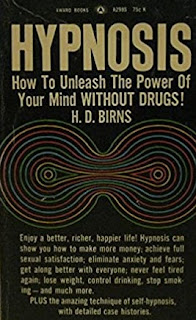
Book Report: Hypnosis (How to Unleash The Power of Your Mind WITHOUT DRUGS!) by H. D. Birns (c) 1968

Hypnosis (How to Unleash The Power of Your Mind WITHOUT DRUGS!) by H. D. Birns (c) 1968

This is a very competent introduction to the subject, with good, basic instructions in self hypnosis. As with most other books of this type, it discusses a bit of the history of hypnosis, common conceptions of hypnosis versus actual facts, and a few "case histories" to illustrate how individuals were affected by the use of hypnosis. At the time of writing this book, Hypnosis was practiced primarily by psychologists, and it was one of the possible treatment modalities that they might apply. One interesting historical note is that hypnosis, he says, became popular after WW2 to assist soldiers when there just weren't enough psychologists to go around, and Freudian Analysis (the common approach at the time) took too long.

The title itself is interesting and timely for the '60s when both psychiatric as well as psychedelic/recreational drugs were a hot topic.

The "payload" of this book is a straightforward, basic method of self-hypnosis that readers can use for themselves to create changes in their own habits. He distinguishes three levels of trance to help experimenters get to the levels that are best suited for the changes they want to make, visualization, and post-hypnotic suggestion.. He includes basic instructions for "glove anesthesia" an hypnotic method for pain control, and entire chapters discussing weight control, smoking, drinking anxiety, and general self-improvement. 

Further chapters discuss the spookier, more questionable applications of hypnosis that were particularly hot topics in those Cold War years, including commission of crimes, brainwashing, and subliminal advertising. Hypnotists are generally divided over whether a person can be hypnotized to do things they wouldn't normally do. This author feels that it is possible, and offers cases to back himself up, including legal cases, and the kind  of brainwashing done by Nazis and by the Communist Chinese. His discussion about "Subliminal Perception" (subliminal advertising) was also a hot topic at the time, and he has great faith in the power of it. Finally, he touches on hypnosis for ESP, and introduces Charles Richet's term "cryptesthesia" for telepathy, and feels hypnosis can enhance it. 

Overall, it's a really good, thorough introduction to the subject with enough practical information on self-hypnosis to get a curious beginner started, but without being overwhelming. He addresses a lot of hot-button issues of the time, which are still timely today, and for all the stories and studies he discusses, he includes the authors and sources, which is often not done.I'm actually surprised I wasn't able to find out more information about the author on line.

Wednesday, December 8, 2021

Book Report: The Human Dynamo by Hans Holzer (c)1975

The Human Dynamo by Hans Holzer (c)1975

Background Information: Hans Holzer, a tireless researcher of the paranormal, is the author of over 100 books on various aspects of the paranormal, and has been the inspiration for a number of TV shows about the paranormal. He often worked with well known spirit mediums, including Sybil Leek, who was quite popular in the 1960s. Most recently, his work with various mediums and haunted houses, has been revisited by the 2019 TV show, The Holzer Files (fittingly, 13 years after his death).
You can read more about Holzer on the web and here:
https://en.wikipedia.org/wiki/Hans_Holzer

Another of Holzer's many books on metaphysical subjects. As a professional researcher of the paranormal, Holzer was exposed to all kinds of metaphysical phenomena, including religions, and in this book he synthesizes what he'd learned from various religious practices. 

The title, "Human Dynamo" refers to connecting to a higher power to achieve one's goals. He explains that every religion attempts to put it's followers in touch with Higher Power, either directly or thought the intermediary of a priest of some sort. He compares different perspectives, how some religions embody that Higher Power in some kind of anthropomorphized deity, how some pursue a direct connection and others not, etc. For people interested in comparative religions, this alone will make the book an interesting discussion. He analyses both religion and prayer separately, and feels that prayer can be effective if it follows certain guidelines, and even that there are certain natural laws governing the effectiveness of it.

This book was written in the 1970s, before Law Of Attraction was a big thing, but there was a great deal of interest in both old religion and New Age spirituality, and this book attempts to satisfy those interests. So he deconstructs prayer into a basic system he feels will be effective based on the "natural laws of prayer." He ferrets out the ten elements for a successful ritual, and finally, posits a modern religion for the new age, including practical prayers, designed to connect with a kind of universal power, although he feels it's perfectly fine to imagine that power as a god or looking like anything that appeals to you, if it helps you to connect. 

I found it interesting to not that while he discusses prayer in depth, so far as Asking for assistance, he doesn't really cover the idea of connecting with the Universal Power for it's own sake, as in meditation. 

It's an interesting read. Coming from the 21 century, where my email inbox is continually bombarded with people preaching various spins on Law Of Attraction and Various New Age practices, it's interesting to go back to a time where very few people claimed to know anything, and it was an open and uncluttered field.