Saturday, August 22, 2026

Are You Mediumistic? by Korda Ra Mayne (R.A. Nelson) (c) 1932

 Robert Nelson, AKA Dr. Korda Ra Mayne was a pioneer in the performance art of Mentalism which includes mind-reading and fortune telling shows as well as doing magic shows. He was a radio personality and performed weekly for seven years. A prolific writer, he was one of the first to publish books on the "secrets" of mentalism and magic performance. 
Through his company, Nelson Enterprises, he sold equipment and courses for magicians, mentalist, astrologers and psychics. 

Much of this biographical information comes from around the internet and this tribute page: https://www.mevproshop.com/secret-domain-of-dr-ramayne/nelson-biography.html

 This is a straightforward, no frills, outline for the budding medium or psychic. In a scant 20 pages it has basic information to get anyone started in seances and mediumship, Automatic writing, crystal gazing, telepathy and psychic healing, and more, but it's clear enough that it probably provides everything a person needs ot get started. 

The author's premise is that while everyone has the potential to develop psychic skills it takes a lot of work ond you never know which specialty you'll succeed in without practice and experimentation. And mediumship, the ability to communicate with spirits, is a gift that few possess, but is worth working on. 

This booklet appears to have been printed in many different formats with different cover art since the 1930, and one source says that Nelson Enterprises, the original publisher, also produced versions of the book without the author's name, that could be customized for other resellers. 

My copy, the one shown in the photo above, Lists the publisher (but not copyright!) as Stanray Industries 1971. The facing title page lists the author as "Anonymous," and the back of that page, in smaller letters at the bottom, says Copyright 1932 R.A. Nelson. 

The last few pages list several other publications to appeal to the aspiring psychic, including The Book of Forbidden Knowledge, Six Lessons in Crystal Gazing, and an offer for an astrological reading.  

Friday, August 21, 2026

Book Report: Entangled Minds --Extrasensory Experiences in a Quantum Reality by Dean Radin (c) 2006

Dean Radin, MS, PhD, is Chief Scientist at the Institute of Noetic Science (IONS) and Associated Distinguished Professor of Integral and Transpersonal Psychology at the California Institute of Integral Studies (CIIS). His original career track as a concert violinist shifted into science after earning a BSEE degree in electrical engineering, magna cum laude and with honors in physics, from the University of Massachusetts, Amherst, and then an MS in electrical engineering and a PhD in psychology from the University of Illinois, Urbana-Champaign. For a decade, he worked on advanced R&D at AT&T Bell Laboratories and GTE Laboratories. For over three decades, he has been engaged in research on the frontiers of consciousness. Before joining the research staff at IONS in 2001, he held appointments at Princeton University, SRI International, and other academic and industrial facilities.

He is author or co-author of hundreds of scientific, technical, and popular articles, five dozen book chapters, and five best-selling books.
(the above was taken from his bio at the Institute for Noetic Sciences https://noetic.org/profile/dean-radin/)

Most of the books I collect and write about are old 70s "mind science" books about mental or psychic phenomena, and they generally come in two varieties, either they're just a series of anecdotes, or they're sort of how-to guides. If there's any discussion of how these things might work, it's usually the traditional metaphysical talk taken from traditions like Hinduism, Buddhism, Taoism, etc. So when I heard about this book, I had to check it out.

The book explores the uncanny similarities between psychic phenomena like clairvoyance, telekinesis and precognition with observed phenomena of Quantum physics.

The book is very logically presented and entertainingly written, leading us through categories of "psi" that have been researched, methods of testing and statistical analysis, (and how to spot errors like accidental or deliberate omissions in data). Naturally he also describes the way the psychological tests are structured, both in order to get the purest data and also to avoid any kind of bias. 

The discussion of quantum physics is clear and understandable. One of the early scientists involved in Quantum research defined much of what he observed as "spooky action at a distance," and this is where the corollaries to Psi phenomena come in. Some of the more mind-blowing concepts in quantum physics include "nonlocality" whereby things can interact with each other even when separated by distance or time and the strange quality whereby atomic particles can be particles or waves depending on the way they are observed, and each state has very different qualities. 

Even the title of the book, "Entangled Minds" refers to "quantum entanglement, which is the strange way that, once particles have interacted, they continue to interact forever, no matter how far they're separated.   

The book is thought provoking and a fun read whether you're a true believer or a hardened skeptic or anything in between. and you'll also come away with a better understanding of Quantum Physics and statistical analysis.  

----

I do feel the need to mention one of the other books I've reported on, Science and the Supernatural, by John Taylor. Taylor was a top scientist back in the 70s and 80s, and took the bold step of attempting to find a scientific basis for psychic phenomena. At the time he was writing, mainstream science was even more hostile to Psi research, and quantum physics was still mostly exotic theory. Unfortunately, he reasoned that telepathy and psi phenomena were a manifestation of radio frequencies, but never was able to get his theory to work. Nevertheless, his mere willingness to participate in the study ruined his career. How things have changed!


Monday, August 10, 2026

Book Report-- When she was Bad by Patricia Pearson (c)1997

When she was Bad, Violent Women and the Myth of Innocence by Patricia Pearson (c)1997

Hot on the heels of the notorious Heard V. Depp trial (June 2022), I heard about this book, and it certainly piqued my interest. I'm not usually interested in the true crime genre, but the bizarre soundbites that kept showing up on social media drew me in, and so did the extreme responses of the fans. 'Nuff Said.  

This book is a deep dive, not exclusively into crimes committed by women, but moreso Western Society's perspective on women and crime, both social, legal and scientific. And it may not be what you think it is. Specifically the theme is "the nature of female aggression."

Exploring a number of specific crimes committed by women in detail and examining the public, legal and scientific data about them, the author found that our culturally influenced attitudes about women as the "weaker sex" have created an environment which serves badly both for the victims of women's aggression and for the the women themselves.

In order to clearly highlight the influence of our culture, which is primarily a Western/Christian influence, the author compares cultures less influenced by implicit patriarchal beliefs, where women may be as accepted as aggressive and physical as men, something that, to our culture seems very alien. For example, our western attitude is that women are the better sex, the purer one, but also the one that doesn't think for itself, and never acts, but only reacts. (at the time the book was written, the term "patriarchy" was not in usage as it is now).   

The author manages to walk that razor's edge social attitudes on one side and hard data on the other in order to shine a light on the difficult-to-look-at facts that women are fully human, fully equal to men in all ways, including aggression and violence. At the same time, her writing stays witty, clear and highly readable.

The author manages to span a number of important places and perspectives to give us a thorough picture. She opens the book by looking at other cultures where womens' aggression are more believed and accepted. On an island off Venezuela, for example, it is accepted that women may be as strong or stronger and more violent than the men, and it is a point of pride, something they call Parar El Macho to balance male aggression. In aboriginal societies in Australia and Africa, aggression and violence is about equally initiated by males and females, and women have even been known to lead genocides. 

She also describes her initial difficulty in finding psychological research here in America on women and aggression, simply because most researchers didn't see the point, since their patriarchal attitude precluded the idea of female aggression.  

The book goes on to explore the world of female serial killers, women who murder their kids, women in prison and more (a recent edition, released in 2021, includes a new chapter on medical caregivers and violent crime). Each chapter presents its facts and premises clearly and colorfully (sometimes too colorfully), but with an engaging narrative style, and even a touch of humor. 

Perhaps nowhere is the troubling dichotomy made more obvious than the chapter on women who kill their own children. In previous chapters we find women literally getting away with multiple murders because the authorities sees women as both unable to initiate violence, and too good and pure to really hurt anyone. But one of the many things revealed in this chapter is that many of the mothers who killed their babies actually sought help before they committed murder, but were disregarded as merely suffering normal post-partum depression, and that their natural maternal instincts would soon kick in and make motherhood wonderful for them.

If you were ever fell afoul of the mean girls in school when you were little, if you ever had a bad divorce, if you were ever victimized unjustly by a woman but were told you must be at fault because "women don't do that," you may find this book quite cathartic. 


Saturday, June 13, 2026

Book Report: Master Guide to Psychism by Harriet Boswell (c)1969

 Harriet Boswell  was an enthusiastic experimenter in the area of Psychic abilities. She founded the Aquarian Research Center in Florida, a nonprofit center which offered classes and workshops in ESP research. It was dissolved in 1984. This book appears to have been popular enough to have gone through several printings, at least two in hardcover by Parker Publishing, and several in paperback, at least one by Lancer Books, who offered a number of popular titles in inexpensive paperback.

 This latest addition to my collection of Parker Publishing titles, is another book that might qualify as a first-year textbook at Hogwarts. It touches on a broad range of Psychic phenomena, and includes exercises, tips and anecdotes to help a student along. 

The book follows the usual Parker style, which is very readable, and ends each chapter with a series of useful summary points of the chapter. The author's writing style is very clear and readable, almost conversational. She approaches the psychic topics with stories of her personal experiences and fellow experimenters, as well as some references from other authors. She demonstrates a great deal of confidence in what she writes about. She describes herself as a non-conformist, by which she means that she does not adhere too inflexibly to tradition, advising the would-be psychic to avoid being too rigid in their practice, and be open to inspiration (but regular practice is important to improve). 

There's a nice consistency in her philosophy. She opens with spiritualistic subjects, seances and so forth, and then goes on to discuss everything in terms of the energetic "auras" that surround everyone and everything. All subsequent psychic phenomena relate back to either using the energy of one's own aura, or reading the energetic aura of other things or people. 
 

Some of the topics of the book include:

Mediumship & Séances
The Human Aura & Astral Projection
Telepathy & Thought Transference
Premonition & Precognition
Psychokinesis & Telekinesis 
Automatic Writing
Psychometry Powers

Additional subjects covered include reincarnation, spiritualist churches, the use of Ouija boards, and photographic manifestations of the spirit world.


Sunday, May 10, 2026

Book Report: Transcendental Meditation by Robert Roth (c)1994

Robert Roth is one of the oldest, most accomplished practitioners and spokesmen of Transcendental Meditation, having trained directly with Maharishi Mahesh Yogi since 1972. He has taught and lectured all around the world, for hundreds of schools, corporations and individuals. 

Transcendental Meditation, created by Maharishi Mahesh Yogi, is probably one of the most famous of the popular schools of meditation, having been made popular by the Beatles and various other Rock Stars and celebrities in the 1960s and 70s. It is apparently a very easy and effective way to reduce stress, improve health and do all those things that Meditation is known for. It apparently is based on the practice of repeating mantras ("mantra yoga").

 The book, unfortunately is very disappointing, basically being a sales pitch for the course, but not offering even a hint of any specifics about the method. Rather, it is simply a collection of anecdotes and testimonials form many many students, along with some scientific research, but by avoiding any specifics it becomes rather repetitive. There is better material on the web, and videos from the Yogi himself on Youtube and elsewhere. 

More info can be found at their website: 
https://www.tm.org/


Book Report: Mind Control by Emilio Guzman (c)1976


Emelio Guzman appears to be a Mexican experimenter in the field of psychic communication who came across Jose Silva's famous Silva Method mind control course, and became a strong supporter and, we can assume, teacher. This book is his English translation of his original 1972 Spanish title, Control Mental

This book is an introduction to the methodology behind The Silva Method. Back in the 1970s, The Silva Method, was a very, very popular discipline, taught all over the world in week-long seminars, variously known as Silva Method, Silva Mind Control and Silva ESP. 

Through a series of meditation techniques similar to self hypnosis, the students learned how to live a more stress-free life, how to improve their thinking skills and day-to-day activities and even how to develop their ESP skills. The courses are still being taught. 

This book is a discussion of the science and methodology behind the Silva method, and a number of the areas that the Method claims to be able to improve. It also touches on some of the specific techniques, but isn't a study guide. I guess you have to take the course, in person or one of their recorded courses, to learn the specifics. 

To learn more, you can go to the website:
https://www.silvamethod.com/

Saturday, May 9, 2026

Book Report: Threshholds of the Mind By Bill Harris (C) 2003


 Bill Harris is the originator of Centerpointe Research Institute, famous for their Holosync(c) binaural beat recordings for self improvement and development. He is a pioneer of the Binaural beat technology. He was heavily involved in various forms of meditation and self development before exploring the technology of frequency entertainment.  

 If you're curious about binaural beats and entertainment technology, you'll enjoy this book by one if it's pioneer developers. 

The book explains the technology behind the very successful Holosync recordings, which primarily employ binaural beats to stimulate frequency entrainment, in order to achieve deeper mental states very quickly and reliably. 

Deeper meditative states cause the mind to run at different frequencies. Excited mental states run at a higher frequency, meditative and hypnotic states are much slower (these are commonly referred to as Alpha, Beta, Gamma, Delta, Theta).

Frequency entertainment is the effect whereby an external frequency, like music, can have an effect of our consciousness, and if you've ever experienced loud, pounding dance music, or calming, slow lullabyes, you've experienced the entrainment effect. 

Binaural beat technology is an interesting effect whereby different, specific tones are played into each ear, and the way they interact with each other withing the listener's hearing generates the desired tone. This has proven to be very effective and the result is that the listener can achieve meditative states that normally take meditators a long time to achieve. 

The recordings combine this technology with guided meditations or self help techniques to achieve reliable results. 

 The book is part sales pitch, with lots of testimonials and selling points, part biography and still presents a lot of detailed information about the technology behind the recordings. His personal journey in exploring and developing his materials is as interesting as the science. It offers a lot of practical discussion and techniques for helping one get in control of their thoughts and feelings, whether or not you go in for their products. 

The Centerpointe Research Institute's website can be found here: 
https://www.centerpointe.com/

Book Report: Sorcery by J. Finley Hurley (C) 1985

Imagine an experienced scientist putting aside any professional biases and exploring the idea that people can influence each other and their surroundings through thoughts (more or less) thought alone, analyzing every step of the process in a scientific method and weighing it against established researcher and observations. Well, that's the book we have here.

You'll probably have noticed a lot of books about metaphysical abilities in the book report section of my blog. What makes this one different is that the author is a clinical psychologist and this book is his analysis of "magical powers" through the lens of scientific data and empirical case studies. And he claims to have based it on his own observations and research.

Since "sorcery" can mean a lot of things to a lot of people, it's worthwhile to clarify that the author's focus is primarily telepathy and it's ability to influence people with or without their knowledge, and he also touches on other cases where practitioners seemed to be able to influence people and events in seemingly magical ways. 

Happily, Hurley is a fun and engaging author, and because he also writes as a scientist, he backs up his observation and hypotheses with some kind of scientific reference (at least enough to satisfy himself). This is pretty unique for this kind of book and also very practical for anyone who wants to delve into the research instead of just taking the author's work for it.

The author hypothesizes that the other-than-rational effects of "Sorcery" cannot be justified by the conscious, rational mind and so must originate in the subconscious, which he terms "Cthonic" mind.

He begins with the well researched phenomena of The Placebo Effect, an often observed phenomena where an inert drug or treatment has a demonstrable effect on a patient simply because of the patient's belief in the outcome or had faith in the healer. He also includes the somewhat more controversial Pygmalion Effect, which suggests that the healer's belief in the placebo is as important or more important than the patient's belief. He cites situations where the placebo effect has been used to heal people, and also to curse them. In the author's view, telepathy is the vehicle whereby a sorcerer's influence is most commonly carried, and he quotes many studies that explore different forms of telepathy.  

This book falls short of offering an illustrated blueprint to practice from, but adventurers will find plenty of inspiration to work with in this tome.

 The biggest problem with this particular book is how hard it is to find. When copies do show up on the market, they usually cost several hundred dollars, and in an interview the author admits that even he doesn't own a copy. Fortunately, PDFs do float around the web, and you should be able to find one with a quick search. 


Tuesday, August 13, 2024

Wise Word About Hypnotism and Politics from the Father of MkUltra

Professor George Estabrooks is known mostly by reputation for being the hypnotic mastermind who conceived of some of the more disquieting things to come out of the Cold War, like MK Ultra and the Manchurian Candidate. But he was first and foremost a scientist, and was equally concerned with the inexplicable way dictators could turn sensible people into fanatics, and he wrote at length about it in his book “Hypnotism” (revised 1957, E.P.Dutton). This excerpt is WELL worth a read, and maybe a little self-reflection:

“How can we guarantee that our choice at the polls will be a wise one? Our previous discussion of hypnotism and mob psychology should help. Is this man you listened to on TV last night a genuine leader or is he a rabble rouser? Is he heading a battle of democratic principles or “a battle of the gravy bowl’? We may safely say that, in America, we have the world’s most intelligent electorate and that, on the whole, our politicians are a superior group, so we are not crying panic. On the other hand, as we have said, “when you stop being better, you stop being good,” and on this matter of electing a potential dictator, you will make that mistake once only. From then on, he will take care that your mistakes are always in his favor.

So play a little game with yourself. Sit down and think over that last spellbinder you heard on the platform, over the radio or on television. Behind every argument is someone’s ignorance. You probably are either for him or against him. Why? 

Was he appealing largely to your reason or was his appeal largely to your emotions?—especially on such matters as class privilege, the race issue, religious issues. These matters can be handled along the lines of reason, but the temptation to go over to the highly emotional appeal is very marked. In other words, were you listening to a man of reason or to a hypnotist who aimed to limit your field of consciousness? [earlier in the book, the author explains the hypnotic state as one where the subject is led to be hyperfocused on a single topic] You say you cannot be hypnotized against your will. Perhaps you were hypnotized last night as you listened to that political address over your TV. It might be well to give a little thought to this matter. Don’t worry about the hypnotist in his laboratory. You will probably never meet him. The most dangerous hypnotist may be the man you listened to last week over the radio. You were his subject. His appeal was emotional, inflammatory, an excellent example of prestige suggestion [“Prestige” refers to a kind of authoritarian hypnotic influence, and eliciting strong emotion as a way to create an altered state]. You came away determined that something drastic should be done – on, shall we say, the racial issue. As a matter of fact, you were a very excellent subject. Think it over.

And think about the nature of that kind of hypnotist. He may be, he often is, a man of great intelligence. You may have your own opinions about Hitler, Mussolini or Napoleon, but no one ever accused them of being morons. They could and did use the brains they had with great effect. Their outlook was purely selfish. They used their intelligence to further their own ends. But Hitler was excellent within these narrow limits.”

If you want a concrete example of this "mass hypnosis" effect, consider that in the year following the 1973 movie, "The Exorcist," there was an explosion of people believing they were possessed that persisted for years afterwards. Even during the movie, people passed out, vomited, and supposedly there were even a few heart attacks. But all those people did was sit down in a theater for an hour or so. 

Friday, April 19, 2024

Book Report: Science of Breath by Yogi Ramacharaka (William Walker Atkinson) (C) 1904

 Background Information: The Publisher, The Yogi Publication Society is a press started by William Walker Atkinson at the turn of the 20tdh century to promote his writings on "New Thought," which was the New Age movement of the time. Atkinson himself was quite a character. He was a prolific writer, with over 150 books to his credit, often under any of several pen names. He rose to prominence at the beginning of the 20th century, but seems to have become forgotten in the following decades, though he and the Yogi Publication books are experiencing a new renaissance at the beginning of the 21 century.
Many of the books were written by Atkinson, but they also published other prominent metaphysical works by other authors. The company has changed hands a number of times, so many that the original history was lost to the current owners, but the books are still in print, and still inspiring spiritual seekers.
The author of this book, Yogi Ramacharaka, was one of William Walker Atkinson's many pen names.

This little book (88 pages) is a classic! Despite being over 100 years old, the breathing exercises it offers are easy to practice and very practical. Beginning at the beginning, it thoroughly discusses the western concept of breath and the Eastern concept and why they're important. Of course there's a discussion of Prana, the Hindu word for the metaphysical energy (AKA Chi, or Ki) that is cultivated both through breath and also through meditation, All these chapters are concise and short and they're followed by both basic and additional exercises.
Specifically, you'll discover the Complete Yogi Breath, The Seven Yogi Developing Exercises, Seven Minor Yogi Exercises, Vibrational Breathing, and some other things you can practice as well. There are techniques to use breath and imagery to empower your meditation, health and visualization. 

No New Thought book would be complete without some psychic phenomena exercises and this book includes those as well, so if you want some basic practiced in Thought Projection, Psychic Healing, Charging your Aura and discovering your higher self, that's included too.

Breathing practice is often taught as part of Yoga or Meditation teaching, but it can be practiced all by itself to improve your health and concentration. The book is over 100 years old, so it's no longer protected by copyright. As such, there are a lot of versions available published by a lot of different sources, from the blue hardcover published by Yogi Publication Society, to various paperback versions and even downloadable PDFs that can be found on line. It's well worth a read, and a practical addition to anyone's metaphysical or physical culture book collection.

Sunday, November 19, 2023

Book Report: Clinical Hypnosis by Crasilneck and Hall (c) 1985

 Harold Crasilneck and James A Hall were accomplished clinical hypnotherapists and psychologists who worked extensively in the medical arena. Crasilneck was noted for his work with hypnosis in pain control and Hall was a Jungian psychologist. Together they worked and researched in way that hypnosis can be employed in the medical arena. 

 This book is a more academic textbook than many of the books I've reviewed on this blog, but i think it's a valuable read for serious hypnotists. 

The book is dry and factually dense like many academic works. Through it's many chapters, it touches on valuable applications of hypnosis in many different medical and psychological situations. Each chapter is replete with a great number of footnotes and research references. 

Having been written in 1985, I imagine that most of the research material has been superseded by more advanced knowledge by now, but the sheer number of different clinical applications that they have actual experience and data on is both inspiring and practical. You won't find much technique described, so it's really appropriate for a more advanced practitioner, but it will tickle your imagination as to how far hypnosis can actually benefit people. 

Personally, I also found it interesting to read about hypnosis as described from a psychologist's perspective. Their analysis of some situations, as well as the terminology they use was a very interesting comparison to my training. 

Sunday, July 23, 2023

Body Mass Index --Is the BMI For Real, or is the B for Baloney?


The Controversy:

The Body Mass Index is a common graph used for determining what a patient’s “normal” weight should be, based on their weight and height. Nevertheless, some have claimed it to be outdated, unscientific, inaccurate and even racist. Yet many doctors and weight loss authorities still use it and feel it is reliable. What is it and is it accurate?

 I recently had a visit with my new doctor. Some people dread going to the doctor, but I’ve always looked forward to it. I’m generally pretty healthy. I used to be an athlete, and I still try to keep in pretty good shape. Not great, but pretty good, and usually a little better than my age bracket. A visit to the doctor is normally uneventful, and sometimes even complementary. (Full disclosure: I carry a bit more belly fat than I’d like to, which I credit to years of working long hours, and I’ve got a touch of osteoarthritis from an old car injury). When the COVID lockdown ended, I started hitting the gym nearly every day for an hour or two, and I put on a good bit of muscle, even if I didn't burn much fat.

 I wasn’t surprised when the doctor told me, “You have to lose weight!” In fact, I heartily agreed, “I know! After a year in lockdown I could certainly stand to lose about 20 pounds.”

 “NO! You have to lose 50 pounds! You’re almost morbidly obese!”

 Obese?! For once, I was at a loss for words. Was he even looking at me? There was no one else in the room, but what he was saying didn’t make sense. I’m not a terribly large person, I’m only 5 foot 5”. Twenty pounds lighter and I’d look pretty good. 25 pounds would be pushing it a bit, but FIFTY POUNDS? I’d look like skeleton. Sure I’m a bit chubby, but obese? Morbidly obese?!  

 “It’s THE BMI! BODY MASS INDEX!” he snapped, “It’s your body composition!”

 I thought quickly. “Are you looking at the scale for women, maybe?” I asked, even though he was quoting out of his head. He told me it was the same for men and women. The only factors to consider, he said, were weight and height, but that didn’t make any sense to me. A woman my height might reasonably be much lighter than I am, if she had delicate bone structure and very little muscle or fat. Aside from my spare tire, I’d added enough muscle to my chest and shoulders since the COVID lockdown that the new jacket I bought only a year ago didn’t fit over my shoulders anymore.

At this point, red flags were going up in my mind. I’d never had a doctor say anything like this to me before, and for me, his judgement was coming into question, because what he was saying didn't sound scientific. “You know muscle is heavier than fat?” I felt compelled to ask. He insisted that it didn’t matter. It was all the same, he said, only height and weight mattered. I was flummoxed. 

As far as he was concerned, there was no more to discuss. BMI was everything there was. All of this shook my faith in the doctor, but maybe he was right and I was wrong. He was the doctor after all. Could I actually be the thinnest obese man in history?

As I left the office, I suppressed the urge to eat an entire pizza in protest, and decided to learn a bit about the BMI when I got home.

I Have to Educate Myself
As a motivational coach, I’ve dealt with a lot of weight loss clients. I deal with their feelings and motivations, but I leave the technicalities of weight and diet to their health care professionals. I can help the clients get over their mental and emotional hurdles, but I don’t tell them what goals to reach for. So I knew about the Body Mass Index (BMI), but I didn’t know the specifics.

What little I did know was that the very concept of “body composition” is the ratio of muscle to non-muscle tissue, and for practical purposes of weight loss, what mattered was the percentage of fat versus non-fat, and it’s common knowledge that muscle weighs more than fat of the same volume.

I also knew there were other variables involved. Gender matters. Males tend to have denser bone and muscle than females as a result of hormonal changes at puberty. Another thing to be considered is age. A 20-year old is usually going to have a stronger metabolism and naturally fitter body than a 40-year old, even if the 40 year old exercises a whole lot more, and I’m 60! (I don’t look a day over 58, though). Race and genetics are another issue that has to be factored in. Different ethnicities store fat in different ways and in different parts of the body, and may not offer the same weight/height ratios.There are probably other specific variables as well.
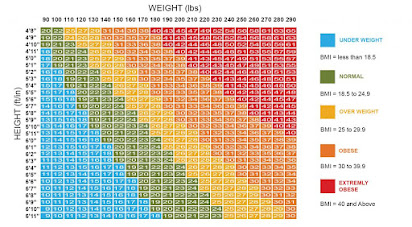

There it is, the BMI chart. And sure enough, It says I’m vastly overweight. But you know what? It might say you’re overweight too! You’ll notice there’s no accounting for any of those other, obvious, variables. I thought there might be a more sophisticated version of the chart and searched for it on the web, but there aren’t any. Maybe the doctor was right, but to my mind, simple common sense says this chart is both incorrect and also unscientific--two variables, height and weight, simply aren’t enough to accurately gauge a person’s health. 

It didn’t take me long to discover a whole lot more. There’s a lot of material about the BMI available, but it wasn’t the dry science I was expecting.

The Quetelet Scale
Are you Belgian? Are you more than 150 years old? If you answered “no” to these questions, the the BMI may not be right for you!

The BMI, was originally known as The Quetelet Scale, after it’s creator was Lambert Adolphe Jacques Quetelet (1796-1874). Quetelet was possessed of one of those brilliant, inquisitive, scientific minds which this period in history produced so many of. He focused his considerable mental powers on many aspects of the natural sciences and the arts, but his two greatest passions were astronomy and mathematics. Stars aside, He felt that numerical statistics could capture and describe the idealized perfection of nature (which he believed to be graphed as a bell curve). He further felt that once that mathematical ideal was established from a small pool of data, it could be generalized out reliably to a much larger population. To that end, he compiled statistics on all kinds of things, including crime rates, marriage rates and, since he was artistically inclined, perfect human proportions. He came up with the formula for the ideal human body based on the formula: weight x height2. In other words,  'the weight increases as the square of the height' This formula was based on measurements from the humans he happened to have at hand, and is sort of the way you's measure the volume of a milk bottle. He published his findings in 1830, and the numbers have not been revised since. 

He was not a doctor. He didn’t know much about medical or structural variations or about human anatomy, and he didn’t intend the Quetelet Scale to be a diagnostic tool. It was more of a philosophical exercise.

The Quetelet Scale enters a New Century
Ancel Benjamin Keys (1904 – 2004) was another brilliant scientist of a different century, and a trailblazer in the field of nutrition. We can credit him for the our modern understanding of the relationship of cholesterol to heart disease, the benefits of the Mediterranean diet, and a number of other discoveries which have become the cornerstones of modern nutritional science. He helped formulate special meals for the soldiers in WW2 based on their caloric needs and it’s rumored the (in)famous K-Ration of WW2 got the “K” in Keys’ honor. 

One of his grandest research projects was the Seven Country Study, which charted the relationship of diet and longevity (particularly heart disease) in seven different countries over a period of several decades. He followed the health histories and measurements of hundreds, possibly thousands, of people over the years in order to get a large sampling of data. In order to process and quantify all the data he was collecting, he chose the Quetelet scale out of convenience, because out of all the existing scales for body mass, he felt the Quetelet Scale was mathematically the most complete, and therefor, convenient for his purposes. When he published some of his findings in 1972, he included the Quetelet Scale, which he renamed The Body Mass Index. But he was clear that it was really only useful for processing large amounts of demographic data, not for use on individuals. 

Today
So there we have it. An academic exercise conducted by Belgian astronomer nearly 200 years ago in the search for mathematical perfection, picked up in 1972 as a convenient demographic tool. It does not figure things like muscle vs. fat, activity level, age, gender, nutrition habits or an individual’s genetic variations. It simply calculates the volume of a human body as if it’s a jam jar. 

So why on earth would modern doctors today, people of science, take up this bit of outdated ephemera when modern tools and methods could provide better data? To be fair, a lot of medical experts neither use nor endorse it. Many have come up with better alternatives. Yet some doctors have accepted it without questioning it’s obvious flaws. Many sources on the internet present it as simple fact without any discussion of it’s failings. According to what I’ve been able to glean, many medical schools are still teaching it, and the students are accepting and absorbing it (even though their own eyes are probably giving them contradictory data!). So why would medical schools promote something that one’s own sense contradicts?

I don’t know. According to some of the sources below, the BMI was picked up and endorsed not by medical experts, but by health insurance companies who felt is assessed the health risks of their customers accurately (and with a good safety margin for the company, I’d imagine). Apparently, a lot of people who teach it never even thought to question it. It’s just been passed along by tradition.  

Are There Better Ways To Measure Fat?
If you want to get an accurate gauge of your weight and health, it goes without saying that you should consult with a health care professional who is trained and qualified. They will know the best course of action for you regarding testing, and for helping you reach your own health and fitness goals.

 There are a number other more thorough body mass indices. One that attempts to address the shortcomings of the BMI is the ABSI (A Body Shape Index). The ABSI was created at City College of New York, with an initial pool of test subjects that included over 14,000 people, and it has since been reaffirmed with even larger sample groups. It is still a generalization, but at least it includes more of the obvious, important variables: age, gender, waist diameter as well as height and weight. If more exacting tests are needed, there are a number of them. I’ve listed the common ones below.

Body Composition Testing Methods
Skinfold Caliper Test-- This is a very common test with athletes and body builders, and is considered to be an easy and fairly accurate test for measuring subcutaneous (beneath the skin) fat. It uses a special caliper which pinches the skin in several specific places around the body to measure the thickness of the fat underneath. The thicker the pinch, the more fat. These measurements are then calculated to get an overall average. It can also indicate which parts of the body have the most or least fat stored in them (which can be an important finding in certain situations). There are several obvious shortcomings of this test. It can’t measure fat stored deep inside the body, only under the skin. It can also be inaccurate if too much or too little pressure is applied with the calipers, or if the pinch is too big or too small. Individuals may also have more or less dense skin, regardless of the fat beneath.  

Bioelectric Impedance Analysis-- This utilizes a device that sends an imperceptible electric current through the body, and measures the amount of electrical resistance the body offers. Since fat has a greater electrical resistance than muscle or water, measuring the resistance will tell how much fat is conducting the current. For the test, several electrodes are attached to various parts of the body. The test itself can be done fairly quickly. Some sources feel it’s reliability is questionable, just because there are so many things that can potentially throw off the results--exercising before the test, dehydration, skin temperature, room temperature, medication, etc. Nevertheless its fast and convenient and a good starting point. There are even home devices you can hold between your hands, although their accuracy seems questionable. 

Hydrostatic Weight Measurement--  This is also considered a very accurate measurement of body composition, though some sources indicate it’s considered a bit old fashioned, perhaps due to the complexity of test. An individual’s weight is measured before the test (dry), and then the individual is submerged in a tank of water and weighed again. The theory behind it is that fat is more buoyant than non-fat, so the individual will weight less when submerged. By noting the difference between the wet and dry weight, they can get a pretty accurate measurement of the actual amount of fat by weight.

Dual-energy X-ray Absorptiometry (DXA or DEXA)-- This involves a special scanner that creates an X-ray imaging of the entire body that also measures the density of the various structures--bones, organs, fat and muscle. This is obviously an extremely accurate way of measuring and seeing the fat in different places, and it can also measure density of bones and other organs. It generally takes about 15 minute or less to do.

Thoughts About The Other Controversial Points
In fairness, the BMI isn’t entirely inaccurate, either. It was based on measurements taken from “average” (not physically active) 19th century Belgian men, who tended to be somewhat smaller, and lighter due to the their diet and living conditions. So while modern 20-21st century American and European people across the board are a bit bigger and heavier, the BMI does seem to be more accurate with younger, less physically active women (physical activity tends to add muscle mass and throw off the accuracy).

A number of sources (including a few of the links cited below) state the BMI to be “racist.” By now we’ve established it isn’t a reliable index for any other group except 200 year old Belgians. I don’t know if Quetelet even knew that different human genetic groups had different anatomical specifics, but most likely, he didn’t know or consider it. He wasn’t a medical man. However it’s fair to say it’s application by modern medicine to a broad range of race and body types is, at least, misguided.

When I was discussing this with someone, they asked why the gender discussion is only in terms of male and female and ignores more of the gender variations that are accepted in the 21 century. I have no answer to that, since I didn’t find any data about that. I imagine that this is why it’s important to have qualified professionals interpret the data, and that we’ll see more variation in the future.

 
***

Note that this article is purely for information and perhaps entertainment value, and is not intended to provide medical advice or diagnose anything. Always consult with the appropriate, qualified professionals about all your health concerns.

***

FURTHER READING:
Quetelet and the BMI
https://en.wikipedia.org/wiki/Adolphe_Quetelet

https://pubmed.ncbi.nlm.nih.gov/17890752/

https://www.healthline.com/nutrition/is-bmi-accurate

https://academic.oup.com/ndt/article/23/1/47/1923176
(This excellent article has a much more detailed historical and scientific discussion than most)

https://www.businessinsider.com/bmi-is-bogus-best-way-to-tell-if-youre-a-healthy-weight-2016-9

https://www.npr.org/templates/story/story.php?storyId=106268439

https://www.cnet.com/health/nutrition/why-your-bmi-just-isnt-that-important/

BMI And Race
https://elemental.medium.com/the-bizarre-and-racist-history-of-the-bmi-7d8dc2aa33bb

https://www.medicalnewstoday.com/articles/265215

https://www.healthline.com/nutrition/bmi-for-black-women

https://www.cnet.com/health/whats-the-difference-between-bmi-and-body-composition/ 

 Ancel Keys and the Seven Country Study
https://en.wikipedia.org/wiki/Ancel_Keys

https://en.wikipedia.org/wiki/Seven_Countries_Study

https://pubmed.ncbi.nlm.nih.gov/31338844/

Better Body Weight Measurements
https://www.ncbi.nlm.nih.gov/pmc/articles/PMC5612697/

https://www.nature.com/articles/s41598-020-71302-5

https://www.absicalculator.eu/

https://www.absi-calculator.com/

Fat Calipers
https://www.muscleandstrength.com/tools/measure-bodyfat

https://www.verywellfit.com/calculate-body-fat-by-measuring-skinfolds-3120273

https://www.fitstream.com/articles/how-to-measure-body-fat-using-calipers-a38

http://www.linear-software.com/online.html
(web page has built in calculators for six different methods)

Bioelectric Impedance Analysis
https://www.verywellfit.com/bioelectrical-impedance-analysis-bia-3495551

https://en.wikipedia.org/wiki/Bioelectrical_impedance_analysis

https://www.ncbi.nlm.nih.gov/pmc/articles/PMC4118362/

https://nutritionj.biomedcentral.com/articles/10.1186/1475-2891-10-35

X Ray Imaging
https://radiology.ucsf.edu/blog/dxadexa-beats-bmi-using-x-ray-exam-measure-body-composition-fat-loss

https://www.ncbi.nlm.nih.gov/pmc/articles/PMC1079847/

https://health.ucdavis.edu/sports-medicine/resources/dxa-info

https://www.sciencedirect.com/science/article/abs/pii/S0261561405002098

Hydrostatic Weight Measurement
https://en.wikipedia.org/wiki/Hydrostatic_weighing

https://www.verywellfit.com/what-is-hydrostatic-underwater-weighing-3120276


Friday, July 21, 2023

Book Report: Training Manual for Sight Without Eyes - Through Mind Sight and Perception by Lloyd Hopkins c.1988/2008

 You can't get more straightforward of a book title than the title of this book. It's a 2008 reprint of a booklet originally published in 1988, and apparently it was a free handout at the author's Mind Sight and Perception Research Center in Washington State. (The author, Lloyd Hopkins, died in 1994, and his center is no longer in operation, but his work seems to have inspired others to continue his explorations, including author Sean McNamara in his book "Mind Sight" I believe he is also giving workshops). Hopkins' center seems to have been in operation from 1970 to 1988, and produced a number of successful students and teachers). The book has been reproduced with all the typos intact but that detracts nothing from the material.

In a nutshell, the author taught people, particularly blind people, to be able to see without the use of their eyes!

This work itself is fairly brief, but still covers a lot of ground. After a health issue in 1968, Hopkins' decided to withdraw from business and devote himself to exploring metaphysical topics that interested him. He doesn't go into any great detail about his beliefs, but seems to have been somewhat influenced by Christianity and he also specifically cites Max Freedom Long's book The Secret Science Behind Miracles, which covers elements of Huna, a system of Hawaiian mysticism. 

The book touches on every aspect of Hopkins' Mind Sigh Center, including practice, philosophy, anecdotes about the students and the school, including a number of public demonstrations they gave to various schools, organizations and even the press, which included reading without use of the eyes, being able to perceive events at great distances, and even driving a car sightlessly! The author doesn't attempt to explain how Mind Sight works, but that doesn't appear to have been particularly important.

The practical part of the book presents a series of beginner advanced exercises. Some of his explanations are a bit sparse and vague, but later in the book he includes some short autobiographies of his outstanding students and some go into greater detail about the training methods. He insists that with intense commitment and practice, almost anyone can achieve some lever of success.

If you have an interest in Huna, Psychic skills or Remote Viewing, this book will be a fun and perhaps useful addition to your training materials.

Thursday, March 16, 2023

Book Report: Outliers by Malcolm Gladwell (c)2008

Outliers by Malcolm Gladwell (c)2008

Background Information: "Malcolm Gladwell is the author of five New York Times bestsellers — The Tipping Point, Blink,Outliers, What the Dog Saw, and David and Goliath. He is also the co-founder of Pushkin Industries, an audio content company that produces the podcasts Revisionist History, which reconsiders things both overlooked and misunderstood, and Broken Record, where he, Rick Rubin, and Bruce Headlam interview musicians across a wide range of genres. Gladwell has been included in the TIME 100 Most Influential People list and touted as one of Foreign Policy’s Top Global Thinkers." (from the Author's web page: https://www.gladwellbooks.com/)

"Outliers" are those people and things that are outside of the normal range of things, the statistically improbable, the rarities. There are a lot of books highlighting the stories of successful people, their struggles and skills and luck, but here, the author has noticed that in every sphere there are some small coincidences. Why were Bill Gates, Steve Jobs, and other revolutionaries of the microcomputer age all born within a few years of each other? Why are all the great hockey players born in the Spring, why was Germany vital to the Beatles' success, and why is it so important to consider the events surrounding plane crashes in figuring all this out?

Here's a hint: success isn't just a matter of genius or hard work (although you're read about why the famous "10,000 hour rule of mastery is so important). A person has to enter the scene at the right time and place for that genius to have an opportunity to take root. and that situation has to have the resources to nurture that talent, too. If you're not sure if this is so, be sure to read about the worlds smartest man that you never heard of to put it in perspective.

Not only is the topic clearly presented and researched, but Gladwell's writing skills are both powerful and entertaining. The book is enormously entertaining and readable, and hes careful to continue to fit all the facts he presents into one solid, continuous discussion. There are some books that present facts in a way that you feel you need to keep notes from the previous chapters, but in Gladwell's books, it's a continual build up and reflection so that it's an effortless read.

This book will expand your understanding of how these outliers are both unique talents and products of their environment at the same time.

Monday, September 26, 2022

Book Report: Subliminal: How Your Unconscious Mind Rules Your Behavior by Leonard Mlodinow (C)2012

Subliminal: How Your Unconscious Mind Rules Your Behavior by Leonard Mlodinow (c) 2012

About the Author: Mlodinow is a bestselling author, theoretical physicist, researcher, inventor and screenwriter. He even coauthored a book with Steven Hawking, and has authored episodes of Star Trek: The Next Generation and McGuyver. He currently teaches at Caltech.

I probably would have bought this book for the cover design alone. In addition to the straightforward title and description on the eye-catching hot green cover, "How your subconscious mind rules your behavior" there's a clever and funny "subliminal" messge printed in glossy, clear varnish all over the book. It's entirely transparent and only seen when the lights hits it in the right way (you can see it in grey on the picture left: Psst... Hey There, Yes, You, Sexy, Buy This Book Now. You know You Want it." The Spine and back cover are overprinted with "BUY! BUY! BUY!"). As a long time Ad-man, myself, this appeals to me enormously. 

You can expect the same kind of wry humor throughout the book, and happily it's used to make the science he's presenting readable and fun. The topic of this book is, as you may have guessed, how the subconscious mind works with the conscious mind in ways we're usually unaware of. Now, the subconscious is far to big a topic for any one book or author to cover completely (even if it were possible to know and understand it completely, but new discoveries are being made every day). But there's no question that this book is a valuable and fun addition to the library of anyone serious about getting a better understanding about the mind. 

Coming from a scientist, it's no surprise that he's start with history and hard science, and he quickly brings us up to date with the different ways the mind was perceived by scientists as the science rapidly developed. We're also introduced to the way brain structures and neurology affect our perceptions (did you know there's a non-visual part of the brain wired directly to the eyes that recognizes faces even if the visual portion od the brain is totally non-functional? It is possible to recognize facial expressions even if one cannot see the face! It's called the "Fusiform Face Area").